
Medicine
About Medicine
Physicians may be allopathic (MD) or osteopathic (DO) practitioners after attending an accredited osteopathic or allopathic medical program, completing a residency, and taking board exams.
Medical programs are 4 year graduate degree programs where you learn the fundamentals of medical practice whereas residency is a post-graduate training process which may be 3-7 years depending on the field. Most physicians work with patients full-time, however others also teach, engage in research, work in administration, and contribute to healthcare policy.
On this page: Degree & Certification Paths | Explore Your Interest in Medicine | Preparing for Medical School | Find a Program & Apply | Career Resources | Related CPHA Canvas Courses
Degree & Certification Paths
The M.D. is a four-year degree administered by medical schools, culminating with the USMLE, the medical licensing exam.
After medical school, most doctors continue on in a residency program where they receive more specialized training.
The D.O. is a four-year degree administered by osteopathic medical schools. Training for an M.D. and D.O. are quite similar and degree recipients are licensed to practice medicine. Osteopathic medicine, however, emphasizes a holistic approach to medicine in focusing on the whole person. D.O.s must take the COMLEX licensing exam, and can practice across the full scope of specialties in the medical field.
Combining a Ph.D. with an M.D. or D.O. degree prepares students for careers in academic medicine, such as a medical school professor or biomedical researcher.
Adding a Ph.D. adds three to four years to a student’s medical school program, so you finish after seven or eight years rather than four. You go on to complete a medical specialty, just like other M.D. or D.O. graduates.
Explore Your Interest in Medicine
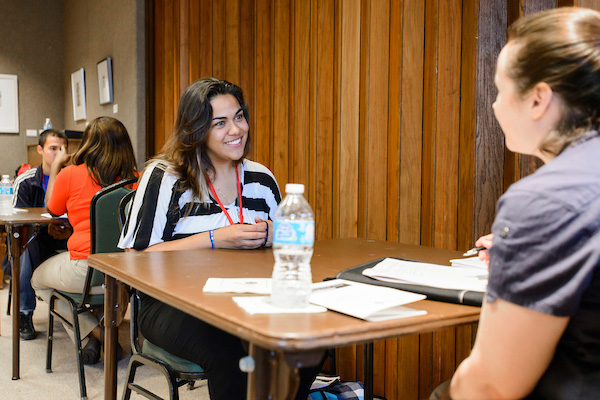
Shadowing & Informational Interviewing
An excellent way to explore your interest in medicine is by working directly with providers. Conduct informational interviews with providers you admire and ask them about how medicine has changed since the start of their practice.

Volunteering
Health professions programs look for applicants who demonstrate a sustained commitment to serving others in healthcare and community settings. Learn more about opportunities to volunteer in clinical and non-clinical settings.
Jobs & Certifications
Explore patient care roles and other health jobs to gain experience working with sick people. Confirm that this work is something you enjoy!
Preparing for Medical School
Medical schools use a process called holistic review to weigh personal factors, academic preparation, and professional experience when reviewing an applicant’s “readiness” for medicine. Put together, these create a picture of you as a whole person.
In addition to having a clear motivation for the field, completing required coursework, experience in clinical and community settings, participating in research, hobbies and interests, and completing the MCAT are common admissions factors for medical schools.
MD/DO Required Coursework
Requirements vary from school to school, so it’s always necessary to consult program websites. This table from the AAMC can help you get started. Pre-requisite courses may include:
| Topic | Credits/Semesters | UW-Madison Courses | Is AP Accepted? |
|---|---|---|---|
| Biology | 8-10 credits or 2 semesters Usually labs are required. | Choose one of the following sequences: Zoology 101-102 and an additional bioscience course with lab such as Botany 130, Anat&Phy 335/435, OR Anat&Phy 337 and 338 Biology 151-152 Biocore 381-382 AND 383-384 satisfies Intro to Bio requirements *Biocore: Students must apply to enroll in Biocore. For more information, visit the Biocore Website | If you have AP credit for Biology, plan to enroll in additional advanced Biology (see Advanced Biology section below) once you’ve finished your intro Biology sequence. |
| General Chemistry | 8-10 credits or 2 semesters Usually labs are required. | Choose one of the following sequences: Chemistry 103-104 Chemistry 109* Chem 115-116 (intended for Chem majors) *Many accept Chem 109 as equivalent to two semesters of inorganic chemistry; some may ask for a letter from the UW-Madison Chemistry Department describing the condensed nature of Chem 109. See Pre-Health Advising for more information if you have taken Chem 109 | Most schools will accept AP credit for Chem 103. |
| Organic Chemistry | 6-8 credits or 2 semesters Usually labs are required. Some schools will accept 1-semester of Organic Chemistry with 1 semester of Biochem. | Chem 343 Introductory Organic Chemistry Chem 345 Intermediate Organic Chemistry Chem 344 Introductory Organic Chemistry Lab | |
| Physics | 8-10 Credits or 2 semesters Usually labs are required. | Choose one of the following sequences: Physics 103-104 (algebra-based) Physics 201-202 (calculus-based; intended for Engineering majors) Physics 207-208 (calculus-based; intended for Life Science majors) EMA 201 + Physics 202 + BME 315 (for BME majors) Physics 247/248/249 (for Physics majors) * If physics is required for your major, select the sequence recommended by your major. If physics is not required by your major, physics 103-104 is an appropriate choice | Most schools will accept AP credit for at least one physics course. |
| Biochemistry | Some schools require 3 credits or 1 semester. | Choose one of the following courses: Biochemistry 501 Biochemistry 507-508 (intended for Biochem majors) | |
| Social Science | This varies widely across programs from courses being recommended up to 24 credits. | Required for the MCAT: Intro Psych 202 Plus, an intro Sociology course such as: GWS 103 – Gender, Women, Bodies and Health GWS 200 – LGBTQ Studies Soc 120 – Marriage and Family Soc 125 – American Society Soc 134 – Race and Ethnicity Soc 138 – Sociology of Gender Soc 140 – Community and Environmental Sociology Soc 170 – Population Problems Soc 181(H) or 211 – The Sociological Enterprise Soc 210 – Survey of Sociology | If you have AP credit for Social Science, you should enroll in additional Social Sciences course(s) in college. |
| Humanities | Plan on taking 6 credits of English. | This spreadsheet compiles English requirements for all U.S. MD & DO programs and is current as of February 2026: Medicine English Requirements. | If you have AP English, you should take higher level English classes in college. |
| Advanced Biology | If you are not majoring in biological science, plan on taking at least one additional advanced biology course with a lab. | Some suggestions include: Anatomy & Physiology 335 or 435 Microbiology 303-304 Cell Biology 570 *Biocore 485-486 Organismal Biology lecture/lab *Must be enrolled in the Biocore program | |
| Statistics | 3 credits or 1 semester Can be taken in Major department | Statistics 301 – Introduction to Statistics. Excellent choice for students with no prior knowledge of statistics and no experience coding. Statistics 371 – Introductory Applied Statistics for Life Sciences. Excellent choice for students who have AP credit for Stats 301 and wish to take a math/statistics course at the college level. This course teaches coding in “R.” Statistics 240 – Data Science Modeling. Excellent choice for students who have AP credit for Stats 301 and wish to take a math/statistics course at the college level. This course teaches coding in “R.” If you don’t have credit for Stats 301 or 371 and take Stats 240, you should plan on taking Stats 340 for a deeper understanding of handling and analyzing data. Introductory statistics in your department – Most schools accept introductory statistics from your major (Psych, Soc, Engineering, Business etc.), but check requirements! | Schools are more willing to accept AP stats if you have at least one math class at the college level. |
Working or volunteering in hospitals, clinics, and other healthcare settings gives you a chance to work with patients and health care teams and is essential experience to have when applying to medical programs. Ideally, you want to have at least one year of volunteering at the time you apply, but keep in mind that competitive applicants often have more experience and often have paid experience.
Choose opportunities that give you exposure to clinical settings and allow you to work with patient populations or in specialties that interest you!
Medical programs look for applicants who demonstrate a sustained commitment to serving others in healthcare and community settings. When looking for ways to get involved, choose organizations or causes close to your heart. Learn more about opportunities to volunteer in clinical and non-clinical settings by visiting our Volunteering page.
Research is an important way to develop skills that help you hone your capacity to learn and begin to contribute to the generation of new knowledge in fields of inquiry. Working in a research lab also gives you the opportunity to cultivate relationships with faculty who can serve as letter writers when you apply to medical school.
The most important thing we want you to know about preparing for the MCAT is that CPHA is here to help! CPHA has developed a series of modules in Canvas as resources to help you prepare – whether you choose to buy a course or whether you want to prepare as cheaply as possible! Enroll in CPHA’s MCAT 101 course to learn more about the MCAT, find study plans, and discover free and low cost resources.
What is the MCAT?
The Medical College Admission Test (MCAT) is a standardized content exam designed to assess your content knowledge in areas of biology, chemistry, physics, and social science as well as your ability to reason through scientific research, evaluate data, and analyze writing from a broad range of topics. Here is an overview of the test day and how the content areas are distributed on the exam:
MCAT Exam Overview
| Section | Number of Questions | Time Allotted |
|---|---|---|
| Test Day Certification | n/a | 4 minutes |
| Optional Tutorial | n/a | 10 minutes |
| Section 1: Chemical & Physical Foundations of Biological Systems | n/a | 95 minutes |
| Optional Break | n/a | 10 minutes |
| Section 2: Critical Analysis and Reasoning Skills | 53 | 90 minutes |
| Optional Mid-exam Break | n/a | 30 minutes |
| Section 3: Biological and Biochemical Foundations of Living Systems | 59 | 95 minutes |
| Optional Break | n/a | 10 minutes |
| Section 4: Psychological, Social, and Biological Foundation of Behavior | 59 | 95 minutes |
| Void Questions | n/a | 3 minutes |
| Optional Survey | n/a | 5 minutes |
| Total Content Time | 230 | 6 hours, 15 minutes |
| Total Test Time | 230 | 7 hours, 30 minutes |
Before the MCAT: Recommended Coursework
The MCAT is a content based exam, meaning you need certain courses before taking it. The courses you should complete before taking the MCAT include:
Pre-MCAT Coursework
| Subject | Course Options at UW-Madison |
|---|---|
| Introductory Biology | Zoo 101 & additional intro bio such as Botany 130 Bio 151 & Bio 152 Biocore 381 & 383 |
| General Chemistry | Chem 103-104 Chem 109 Chem 115-116 |
| Organic Chemistry | Chem 343 & 345 *Chem 344 lab is not required, but helpful for the MCAT |
| Physics | Physics 103-104 (algebra-based) Physics 207-208 (calculus-based) Physics 201-202 (calculus-based; for engineering majors) |
| Biochemistry | Biochem 501 Biochem 507-508 |
| Social Science | Intro Psych 202 & an intro Sociology course such as: GWS 103 – Gender, Women, Bodies and Health GWS 200 – LGBTQ Studies Soc 120 – Marriage and Family Soc 125 – American Society Soc 134 – Race and Ethnicity Soc 138 – Sociology of Gender Soc 140 – Community and Environmental Sociology Soc 170 – Population Problems Soc 181(H) or 211 – The Sociological Enterprise Soc 210 – Survey of Sociology |
| Helpful Courses (Not Required) You might take one of these to strengthen your knowledge in an area. | Physiology 335 Biochem 510 Neurobio 523 Cell Biology 570 Immunology 341 Genetics 466 Microbiology 303 |
MCAT Timelines
After you take the MCAT, it takes a month to process your score. Students who are applying to a health professions program in their junior year should take the exam in spring of their junior year – ideally in April – to ensure they receive their score before they submit their application.
If you apply as a senior or later and take one or more gap years, you have choices! Many students taking a gap year will prepare for the MCAT over summer of their junior year and take it in August. You may also take it in January, March, or April of your senior year.
Studying for the MCAT
There isn’t one “right” way to do well on the MCAT, but people who are successful do these things:
- Assess yourself! Be honest with yourself about:
- Your attention span and the breaks you need
- Your test stress – you will need longer to prepare if you have high test stress
- The types of resources that work for you. It’s o.k. to try new study techniques and tools, but you cannot use all of them. If you convince yourself that you must complete everything in one section before you can move on, you will not make progress.
- Carve out regular time to study. You MUST build this into your schedule. If you study during the regular semester, treat the MCAT like a difficult 3 credit class and block time for it like class!
-
- If you have high test stress, carve out 16 hours/week over 20-24 weeks
- If you have low test stress (exams are your superpower!), carve out 16 hrs/week over 8-10 weeks
- If you have normal test stress, carve out 16 hrs/week over 16 weeks
-
- You might take a course if you know you need the structure of a course and want some tutoring that often comes with it. However, you do not need a course to do well on the MCAT if you can structure your time.
- Practice reading online so you get faster at reading passages
- Take practice exams! Take a practice exam before you start studying to see where your strengths and weaknesses are and to get a sense of what it feels like to keep up your academic stamina for 7 hours! The way you spread out your other practice exams depends on various factors, but practice exams are a powerful teaching and training tool for the MCAT!
Find a Program & Apply
The American Association of Medical Colleges (AAMC) has a list of MD medical programs in the US including those that do not use the American Medical College Application Service (AMCAS). They also have the Medical School Admissions Requirements (MSAR) available for purchase (or free with fee assistance).
The American Association of Colleges of Osteopathic Medicine (AACOM) has the Choose DO Explorer with information on DO programs in the US including those that do not use the American Association of Colleges of Osteopathic Medicine Application Service (AACOMAS).
Most schools also give you a chance to submit additional essays that are specific to their school called secondary essays. These essays are a chance to “speak” directly to a school about your interest in their program.
Interviews for medical programs can begin as early as August and go through the following March! In April and May, schools (and applicants) finalize their decisions, and you begin medical school in July or August. The entire application process takes a full year!
Career Resources
-
American Medical Association (AMA)
-
American Osteopathic Association (AOA)
-
American Association of Medical Colleges (AAMC)
-
American Association of Colleges of Osteopathic Medicine (AACOM)
-
American Medical Women’s Association (AMWA)
-
American Muslim Health Professionals (AMHP)
-
Association of Black Women Physicians (ABWP)
-
Association of American Indian Physicians (AAIP)
-
Gay and Lesbian Medical Association (GLMA)
-
National Council of Asian Pacific Islander Physicians (NCAPIP)
-
National Hispanic Medical Association (NHMA)
-
National Medical Association (NMA)
-
UW Madison Student Organizations Related to Health & Wellness
Related CPHA Canvas Courses
Pre-Health 101
Our most important advising resource for first year students is Pre-Health 101, our online orientation on Canvas. It provides an overview of pre-health classes, activities, application timelines, and more.
Applying to Medical Programs
CPHA runs a Canvas courses called Applying to Medical Programs, a non-credit course designed to help you with the process of applying to MD and DO programs. On this course, you’ll learn about essays and school selection, paying for medical school, information for re-applicants & DACA/international students, and more!
MCAT 101
CPHA runs a Canvas course called MCAT 101, a non-credit course designed to help you with the process of preparing for the MCAT. On this course, you’ll find tips on creating a study plan, tracking your progress, using stress to your advantage on the test, and more!