Medical Dosimetry
About Medical Dosimetry
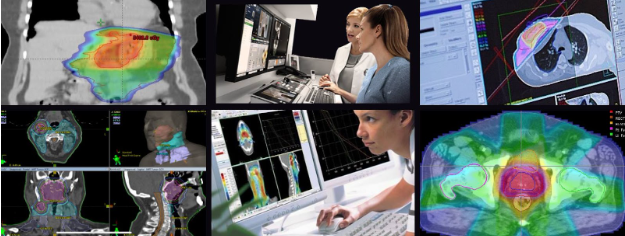
According to the American Association of Medical Dosimetrists (AAMD), Medical Dosimetrists work closely with radiation therapists, medical physicists, and radiation oncologists as part of the radiology oncology team. More specifically, they use knowledge of mathematics, physics, anatomy, physiology, radiobiology and the machines and equipment used in radiation oncology, to design, generate, and measure doses of radiation used to treat patients.
Medical Dosimetrists work in a variety of environments including clinical settings, research and development, education, administration, sales, etc.
In a clinical setting, they can specialize in external beam radiation therapy where radiation is administered outside the body or brachytherapy where a radioactive source is placed inside or near the treatment area.
For the most up-to-date salary information, visit the U.S. Bureau of Labor Statistics website.
UW-Madison does not offer a Medical Dosimetry program. While this field is not among CPHA’s primary areas of advising expertise, we are here to support you in exploring the career, building helpful experiences, and navigating some aspects of professional program applications. Talk with us if you have questions!
On this page: Degree & Certification Paths | Explore Your Interest in Medical Dosimetry | Preparing for a Medical Dosimetry Program | Find a Program & Apply | Career Resources | Related CPHA Canvas Courses
Degree & Certification Paths
Students from the United States need to complete a JRCERT-accredited Bachelors Degree in Medical Dosimetry or complete a Bachelor’s degree (often in the Sciences) and then enroll in a JRCERT-accredited Masters or Certificate Program in Medical Dosimetry.
They will then need to take a certification exam through the Medical Dosimetrist Certification Board (MDCB).
Some of these Masters and Certificate programs have tracks that are designed specifically for Radiation Therapists who are interested in becoming Medical Dosimetrists.
Explore Your Interest in Medical Dosimetry
Shadowing & Informational Interviews
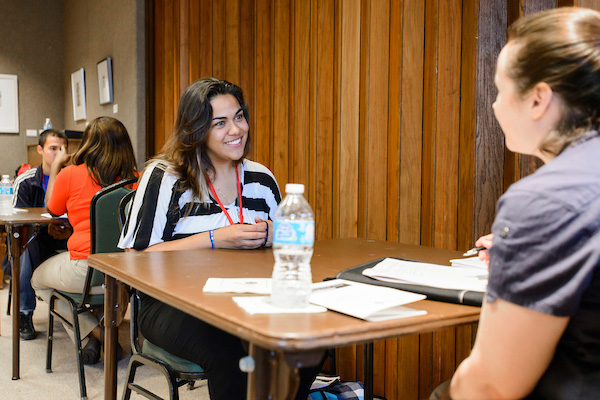
An excellent way to explore your interest in Medical Dosimetry is by talking to a Medical Dosimetrist and observing their work directly. If you have friends or family who work in health care (in any role) ask if they know any Medical Dosimetrists or look for Medical Dosimetrists on LinkedIn, Instagram, or TikTok to see if they are willing to talk about their career.

Volunteering
Medical Dosimetry programs may look for applicants who demonstrate a sustained commitment to serving others. Learn more about opportunities to volunteer in clinical and non clinical settings.
Jobs & Certifications
After volunteering and exploring, working in research or a healthcare setting, potentially providing direct patient care, is a great way to learn about practical aspects of the field.
Additional Exploration Resources
Out of the Gray Podcast interviews folks in the field of radiation oncology to discuss new ideas, research and the future of radiation oncology technology.
UCLA “Hidden Gems in Healthcare: Medical Dosimetrist” Recording featuring representatives from the Medical Dosimetrist programs at Suffolk University, Grand Valley State University and UW-Lacrosse
Preparing for Medical Dosimetry
Medical Dosimetry Required Coursework
Requirements vary from school to school, so it’s always necessary to consult program websites.
Masters programs may require applicants to take the following courses. Radiation therapy courses may also be required for programs designed for folks with a background in Radiation Therapy.
| Topic | Credits/Semesters | UW-Madison Courses |
|---|---|---|
| General Chemistry | 8-10 credits or 2 semesters | Choose one of the following sequences: Chemistry 103-104 Chemistry 109 |
| Biology | 5-10 credits | Choose one of these three sequences: Zoology 101-102 + Additional bio-science course Options include: Genetics, Microbiology, Cell Biology, Immunology Note: you may need to do an additional bio-science course with lab Biology 151-152 Biocore 381-382 AND 383-384 satisfies Intro to Bio requirements Biocore 485-486 Organismal Biology lecture/lab (Satisfies I/A bio) *Biocore: Students must apply to enroll in Biocore. For more information, visit the Biocore Website |
| Anatomy with lab | 4-5 credits | Anatomy & Physiology 337- lecture Anatomy & Physiology 338 – lab |
| Physiology with lab | 4-5 credits | Anatomy & Physiology 335 – lecture & lab |
| Physics | 8-10 credits | Choose one of the following sequences: Physics 103-104 (algebra-based) Physics 201-202 (calculus-based; intended for Engineering majors) Physics 207-208 (calculus-based; intended for Life Science majors) *If physics is required for your major, select the sequence recommended by your major. If physics is not required by your major, physics 103-104 is an appropriate choice. |
| Math | Schools like to see math at the college level | |
| Medical Terminology | 3 credits or 1 semester | Classics 205 |
Find a Program & Apply
The Joint Review Committee on Education in Radiologic Technology (JRCERT) has a program directory with information on accredited medical dosimetry programs in the US and Puerto Rico (just select “Medical Dosimetry” under “Type of Program”).
Bachelor’s programs typically require that applicants apply to the institution as an undergraduate (or second degree) student. Masters and Certificate programs typically require that applicants apply to their program directly, although they may also need to apply to the institution’s graduate school.
Application materials may include: letters of recommendation, a CV or resume, a personal statement, etc. However, requirements vary from school to school, so it’s always necessary to consult program websites.
Masters or Certificate programs may also require that applicants have obtained a certain number of hours shadowing medical dosimetrists or working or volunteering in a healthcare setting, potentially providing direct patient care. Additionally, if it is a program designed for folks with a background in Radiation Therapy, proof of enrollment in an accredited radiation therapy program or proof of ARRT certification in Radiation Therapy may be required.
Some programs may have fee waivers available. Contact them directly for more information.
Career Resources
Related CPHA Canvas Courses
Pre-Health 101
If you are a first year student or healthcare is a new interest, begin by signing up for Pre-Health 101: our free, self-paced online orientation course. It provides an overview of pre-health classes, activities, application timelines, and more.
Applying to Health Programs
CPHA runs a Canvas course called Applying to Health Programs, a non-credit course designed to help you with the process of applying to programs.