Julia Loosen (BS 2018, MD 2023), Internal Medicine Resident
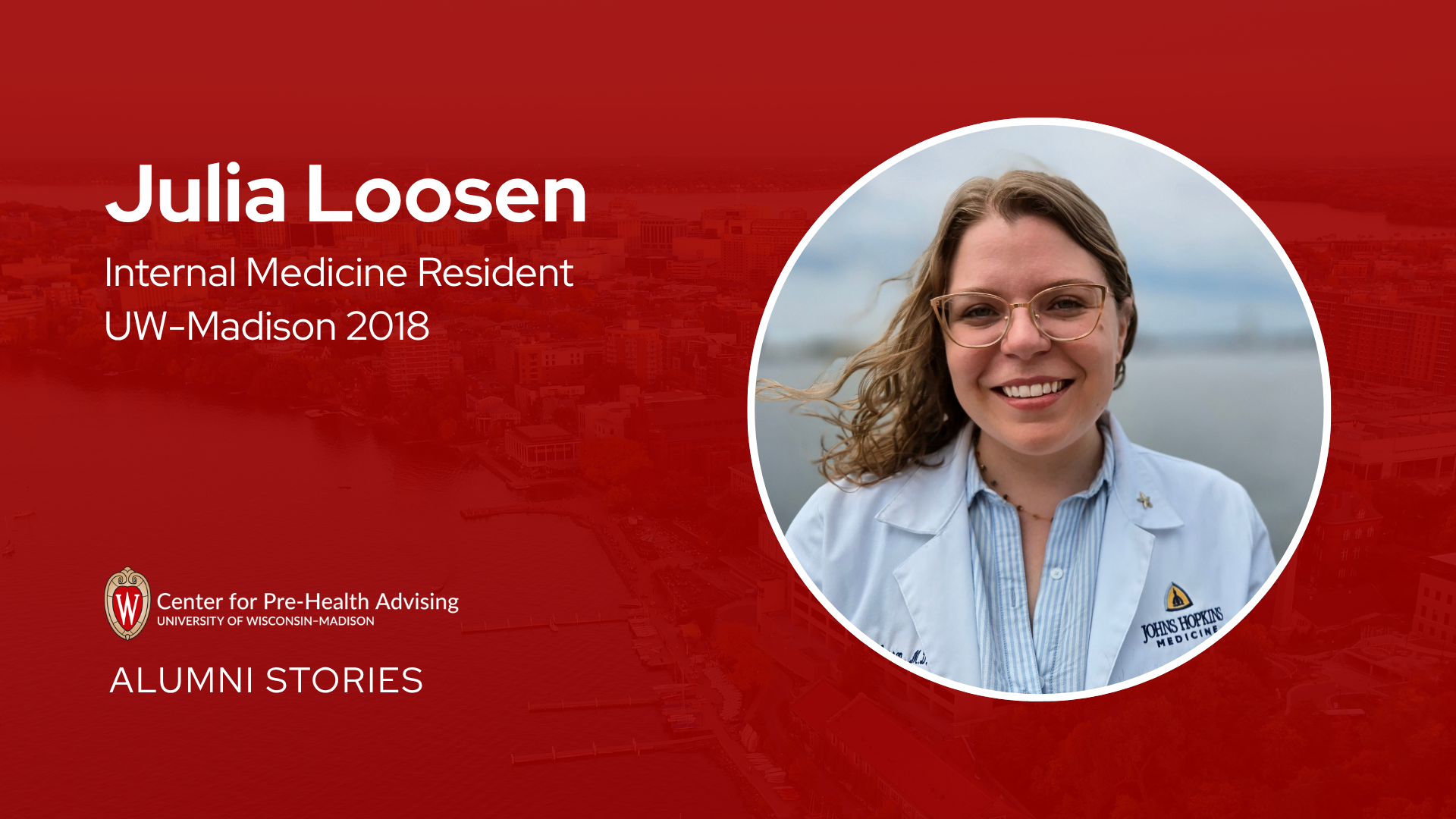
Julia Loosen (UW-Madison ’18) is a third-year resident in Internal Medicine at Johns Hopkins Bayview in Baltimore, Maryland. She will graduate from residency at the end of June 2026, and in July will start a fellowship in Geriatric Medicine, a field dedicated to serving older adults, generally aged 65 and older.
See our conversation with Julia below, where she shares insights into her journey to medical school and beyond, lessons learned, and advice for aspiring healthcare professionals.
Spring 2026 Interview with Julia Loosen
Q: Tell us about your current role and/or studies.
A: I am currently a third-year resident in Internal Medicine at Johns Hopkins Bayview in Baltimore, Maryland. Residency is a period of training after medical school where physicians in training learn skills in a particular area– for me, that means learning to treat adults age 18 and over for a wide range of medical problems. In residency, it is common to “rotate” through different experiences to ensure you are a prepared and well-rounded physician. For Internal Medicine, that means experiences in general medicine wards and clinics, specialties like pulmonary/critical care and cardiology, and even some other areas of medicine like Emergency Medicine and Neurology. I am in a special track within my residency program that focuses on primary care, which means I get to spend more time in clinic being a primary care doctor, which is what I really love!
I will graduate from residency at the end of June 2026, and in July will start an extra year of training called fellowship. In my case, I will be learning more about Geriatric Medicine, a field dedicated to serving older adults, generally aged 65 and older. My ultimate goal is to work as a primary care geriatrician and teach medical students and residents, including spreading excitement about this underrepresented field of medicine. I have also conducted research in geriatrics on social determinants of health and will continue this work in my career. I am passionate about providing patient-centered, comprehensive care to our elders, especially as our population continues to get older.
Q: How did you discover/choose this career path, etc.?
A: Starting in middle school, I was interested in medicine as a career, although no one in my family has been in medicine. I knew going into college at UW that I was on a pre-med path and found an opportunity to work in geriatrics research the summer after my freshman year. After meeting patients and receiving excellent mentorship during that experience, I knew I wanted to serve older adults as my ultimate career. From there, many of my experiences in college, including volunteering and research, were dedicated to that goal. When I finally got to medical school and started my clinical rotations, it only confirmed that I was on the correct path!
Q: What’s one challenge you didn’t expect in your current role?
A: Every day I see complex patients who challenge me to keep learning and do my own research to better take care of them. Even after completing my board exams and finishing residency, there is still so much to learn, which is one of the reasons why I love medicine. There are always new studies and new therapeutics to learn about, and it is easy to be overwhelmed. I have found that taking opportunities to build learning into my day helps me stay updated, which can be attending a lecture, working through a few study questions, or listening to a podcast that reviews new guidelines.
Q: In your role, how often do you work with others vs. independently?
A: In residency, almost everything I do is part of a team, which I really love! I think the best medicine is done when professionals from all backgrounds can contribute to creating a plan for a patient. Even in clinic, we work closely with social workers, case managers, lab staff, nurses, and medical assistants to care for patients. One of the best parts of progressing through residency is taking on more responsibility, which means leading the entire team of medical students and interns, teaching, and getting to shape the patient’s plan of care. Of course, everything we do is supervised by an attending physician, but it is really cool to see how much you learn over the course of training and how independent you can be!
Q: How do you maintain work-life balance?
A: It can be really hard to keep a work-life balance during residency because of the hours that we work, and maintaining a healthy balance is a skill! For me, prioritizing sleep, movement/physical activity, and relatively healthy eating has been helpful in staying both physically and mentally well, no matter how busy it gets. In my free time, I try to get out for walks with my husband, try different coffee shops, and do fun things with my co-residents. As much as I can, I try to get home to Wisconsin to see my family. Some days are easier than others! There are times when I come home from work and fall asleep on the couch instead of doing a workout as I planned, and that’s all part of wellness too!
Q: What is the biggest lesson working in medicine has taught you?
A: Ask for help when you need it! The journey to a career in medicine is very long and difficult– it becomes much easier when you have a team you can rely on. There is no shame in asking for help, whether it is academic support, emotional support, or even help tackling errands or tasks at home to stay on track. There are no bonus points for struggling through things alone.
Q: How did your time at UW-Madison help prepare you for where you are now?
A: My undergraduate education at UW was an essential part of my success in getting into medical school and making me a well-rounded physician. I had rigorous education in biology as part of the Biocore program and participated in the Honors in Research program in CALS, which were both integral to my pre-med preparation. After taking a sociology class my freshman year, I realized that having a social sciences framework to approach health would make me even more well prepared to care for patients in the future, so I added it on as a second major during my sophomore year.
Q: What kinds of opportunities (research, internships, clinics, residencies, etc.) have been most valuable so far?
A: For me, mentorship was a huge reason I was able to pursue medicine as a career. Being a first-generation college and medical school graduate, I had mentors in medicine who were able to advise me as I progressed through undergraduate and into medical school and then on to residency. Through mentors, I was connected to research opportunities, clinical experiences, and networking opportunities. I am so grateful for the faculty who guided me, and I look forward to paying that back in the future.
Q: What advice would you give your younger self?
A: It is okay to not have your journey to medicine look exactly the way you envisioned. I am happy with where I have ended up, but I only got here because there are certain opportunities that I didn’t get and certain unexpected opportunities I said yes to along the way. Now more than ever, there is no traditional path to medicine, and there is room for people from all backgrounds to pursue medicine as a career.
Q: What words of encouragement would you share with students who may be unsure or intimidated by this career path?
A: If you are passionate about lifelong learning and serving others, medicine is a path to strongly consider, no matter your background. We need more people from diverse backgrounds and experiences to care for patients, particularly those who are often overlooked by our healthcare system. While the journey is long, there are so many people along the way who want to help each step of the way. Seek out those helpers and utilize their knowledge and advice.